
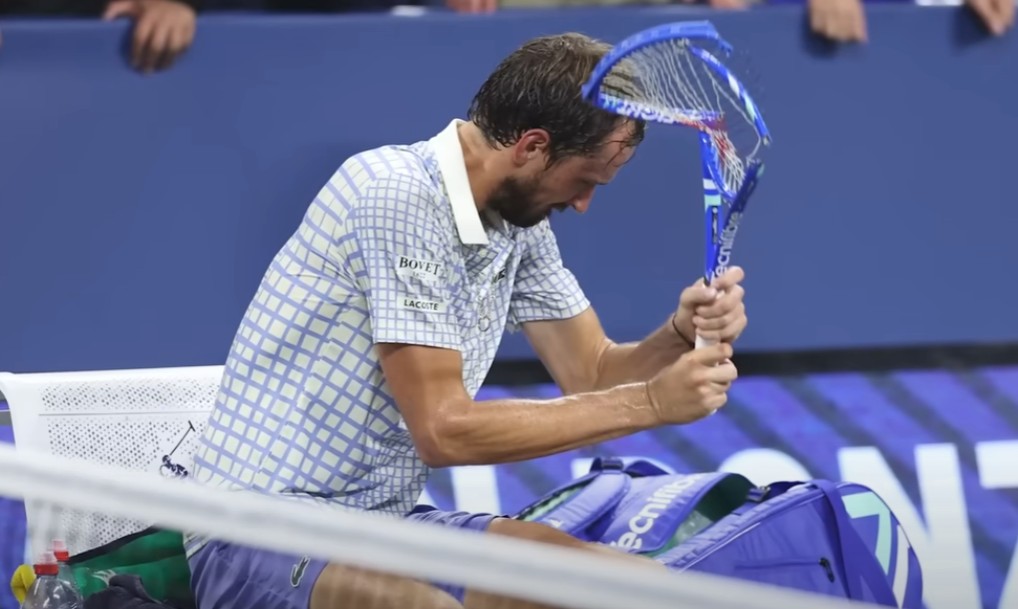
Did you see Daniil Medvedev’s behavior after his first-round loss at the US Open? It was, to say the least, shocking and a disgraceful display of beyond-offensive behavior on a tennis court. It may be the worst behavior I have ever seen from an athlete (and I have seen a lot of awful behavior from athletes in my career as a mental coach!). I’ve heard some commentators try to spin his tantrum as Medvedev being just an emotional athlete or super intense or incredibly competitive, as if those excuse, much less explain, his emotional meltdown.
As someone who has worked with some of the best athletes in the world, including top pro tennis players, let me make this clear. Medvedev’s tirade was inexcusable, and sadly, this was not a one-off demonstration of a monumental loss of emotional control. There is even a TikTok video compilation of his “greatest hits” of bad behavior. His outburst make John McEnroe, of “You cannot be serious!” fame, seem like the Dali Lama.
Medvedev is deserving of all manner of sanctions. I was pleased to see that the US Open fined him more than $40,000. But I don’t believe that is sufficient. The ATP should impose a suspension and other conditions as well. Do I think that such sanctions will mitigate future rants? Not likely, because deterrents are rational, yet his rage is entirely irrational.
I believe that Medvedev’s history of outburst, culminating with his new low demonstrated after his loss to Benjamin Bonzi, warrants a strong response from the powers-that-be of tennis for several reasons.
First, even though he didn’t choose to react as he did, as both a human being and as a professional athlete, he must be held accountable for behavior that is quite simply beyond the pale. Medvedev is fortunate to play at the highest echelon of a sport that has benefited him greatly with both wealth and celebrity. As the saying goes, “with great power comes great responsibility.” If he wants to reap the rewards of his victories, he must also own his defeats with grace and dignity.
Second, to treat a tennis match as Medvedev did is to not only shame himself, but also to disrespect his fellow competitors, many of whom have suffered similar losses, yet manage to accept their defeats with poise and self-respect despite what I’m sure is similar disappointment. Not to mention dishonoring a sport that has the noblest of roots.
Lastly, despite the protestations of Charles Barkley (“I am not a role model.”), every athlete at the top of their sport impacts those who follow them as fans and those who hope to follow in their footsteps as elite athletes. Reacting in ways that any parent wouldn’t allow of their five-year-old child, Medvedev has implicitly endorsed such behavior, sending the message that having a tantrum after a loss is somehow acceptable. It is not. And by minimizing the consequences of such behavior, the leaders of professional tennis do the same.
Though I realize I’m being harsh on Medvedev, I do have empathy for him. Clearly, he doesn’t choose to lose his s&%# emotionally. Rather, there is some incredibly powerful insecurity, some overwhelming threat, some self-shattering fear that resides deep inside of him. Is he aware of what it is that impels him to lose all control? Though I can’t see deep into Medvedev psyche, my best professional guess is no. But make no mistake, that emotional baggage is powerful because such a violent and virulent reaction lies far outside the norms of professional sport and society in general. Plus, it can’t feel good in any way, shape, or form. If he has any sense of decency, he may also feel a deep sense of embarrassment and shame after his outburst. And, at a very basic level, there is clearly little joy in his tennis.
If even a modicum of self-awareness lives within him, my hope and recommendation is that he seek professional help to assist him in exorcising the demons that are unleashed when he plays poorly and loses badly. That is, in my view, his only chance of long-term success in tennis but, more importantly, any level of psychological well-being and mental health as a person. Such introspection and positive change are also likely to be his only opportunity at redemption and only possibility of reclaiming his tennis career.
My hope? That Medvedev can free himself of this destructive side so he can continue to amaze us with his talent and shot-making prowess. If not, he will leave tennis with a legacy unbefitting of someone who has and could continue to bring so much wonder to the sport.