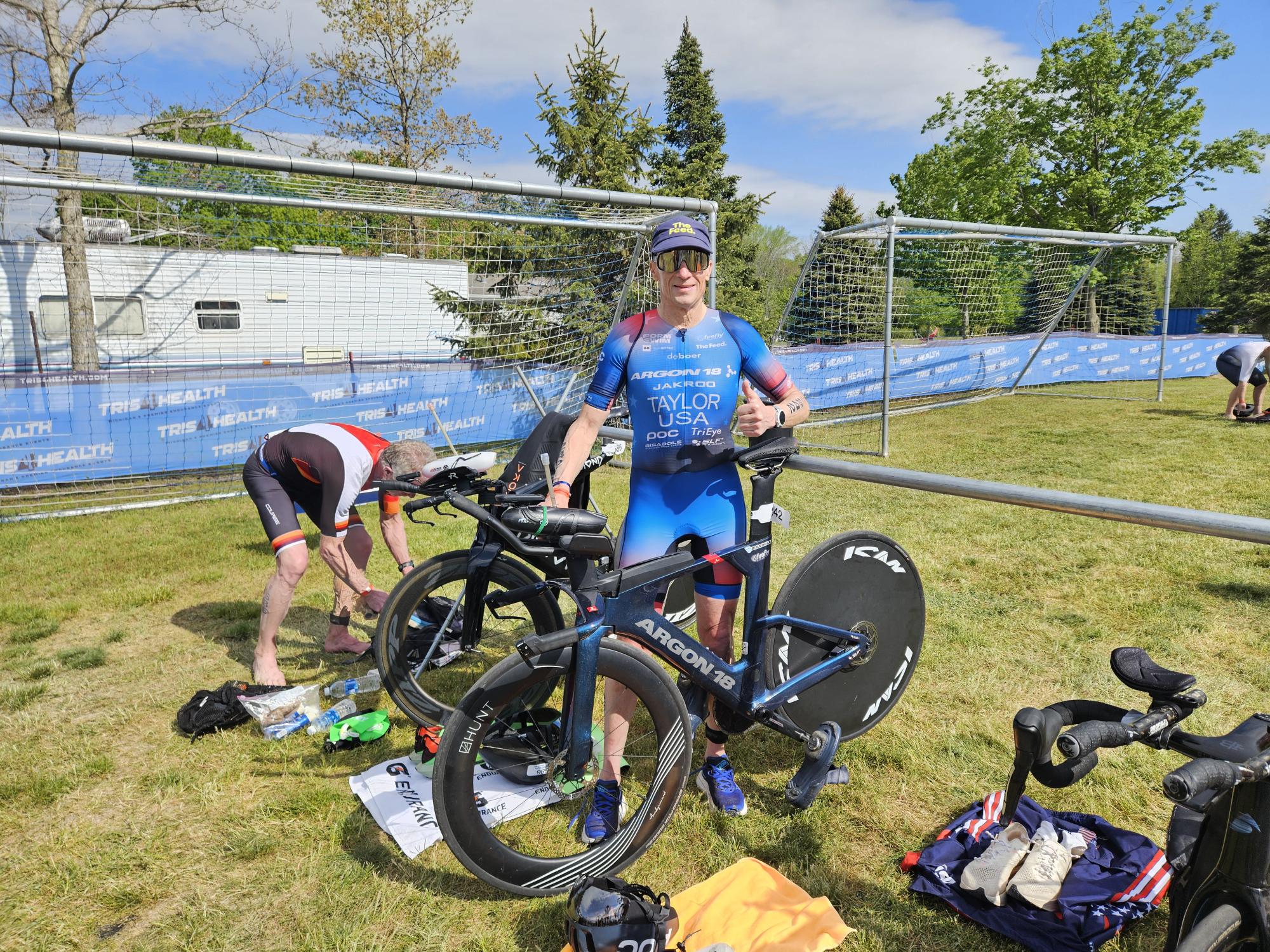
In most universes, my time last week at the 2026 USAT Multisport National Championships in South Haven, Michigan, would be considered a success.
I won my sixth national championship since returning to triathlon in 2022. I also finished third twice and fourth once against some exceptionally strong competitors. Objectively, those are results I should feel proud of.
But I’ve never defined success exclusively by results. Yes, one of the primary reasons I race triathlons is to compete. I’m not  interested in simply participating. I want to test myself against the best athletes in my age group and see where I stand. At the same time, I also know that performance and fulfillment aren’t always the same thing.
And mentally, this year’s Nationals was a struggle. In fact, during the week, I found myself asking uncomfortable questions: Why am I even doing this? Do I still want to compete in triathlon? Is all of this stress worth it?
One of the challenges of being a mental performance coach is that I’m expected to practice what I preach. But there’s a big difference between helping others become mentally strong and managing your own mindset in the middle of emotional discomfort.
Before I’m a mental coach, I’m a person. I’m also a deeply committed athlete whose identity has been shaped significantly by sport and competition for most of my life. That means I’m just as vulnerable to the mental challenges of sport as any athlete I work with.
Maybe the only advantage I have is awareness. I usually recognize when my mindset  has drifted into a dark or unhealthy place. I know the tools. I have the strategies. But knowing what to do and actually being able to do it are not always the same thing.
So what was happening?
I had fallen victim to two of the biggest mental traps I warn athletes about all the time. First, I became too focused on outcomes rather than the experience of racing itself. Second, I created expectations about how I thought I should perform.
Last year at Multisport Nationals, I swept all three of my races. I beat two very strong competitors who had previously beaten me regularly. I entered those races with relatively modest expectations. Honestly, I was hoping to maybe win one race and maybe get on the podium in another, so the trifecta far  exceeded what I thought was possible. And it changed how I saw myself as a triathlete. On the positive side, it showed me that I was far more capable than I thought I was. On the not-so-positive side, those affirming experiences raised the bar for me, for good or for bad, and led me to where I was last week; definitely not the “good place.”
This year was different. One of my strongest competitors and a close friend was unable to race in 2025 because of injury. Somewhere in my thinking, I quietly assumed I would stay on top of all three of my main competitors. I couldn’t get the idea of another “sweep” out of my head.
The problem was that those expectations weren’t grounded in reality. They were based more on ego, memory, and hope than on objective information.
But this is what happens in sport. Success changes us. Once athletes achieve a certain level, it becomes very difficult not to expect more success in the future. Expectations  can quietly shift from “I hope to do well” to “I expect to do well.” That shift in expectations can become dangerous mentally because I wasn’t focused on what I needed to do to achieve my goals. And it felt like I had put on an emotional weight vest; I just felt weighed down. It just made me feel bad.
The result was that, during the long downtime between races, my self-talk became  increasingly negative. I spent far too much time alone in my hotel room thinking, worrying, and anticipating disappointment. At times, my thoughts bordered on dread.
Ironically, this kind of negativity can actually serve a psychological purpose. If we lower our expectations emotionally, we believe we’re protecting ourselves from future disappointment. It’s a defense mechanism. If I expect less, losing won’t hurt as much. Of course, it rarely works that way.
What was interesting is that my mental discomfort before the races didn’t seem to impact my performances once the competitions actually started. Every time I arrived at the race venue, something shifted. The apprehension turned into excitement. By the time I reached the start line, I was fully engaged and ready to compete.
Then, once the race began, I remembered exactly why I still love triathlon. I still love testing myself physically and mentally. I love competing. I love pushing into the pain cave and discovering what I still have inside me. There’s also something deeply satisfying about giving a maximal effort, regardless of the outcome. I actually found myself smiling while on the bike and telling myself—reminding myself—why I race triathlons: Because they’re fun! Ironically, the races themselves were the easiest part of the week mentally. The struggle happened before the starting horn.
Looking back, Multisport Nationals reminded me of several important lessons that apply not only to me, but to athletes at every level.
An excessive focus on outcomes almost always pulls us away from what actually produces our best performances. Unrealistic expectations create pressure that drains enjoyment and increases fear. And when our self-worth becomes too attached to results, sport starts feeling heavy instead of meaningful.
The healthiest and most sustainable mindset is one grounded in the process: effort, growth, challenge, improvement, and enjoyment. That doesn’t mean results don’t matter. Of course they matter. Athletes are competitive by nature. We care about outcomes because competing matters deeply to us. But outcomes can’t be the sole measure of success.
At some point during Nationals, I stopped asking myself, “What if I don’t win?” and started reconnecting with a much better question: “Why do I race in the first place?” The answer had nothing to do with podiums. Okay, maybe a little. Okay, maybe more than a little. But it’s not the bottom-line reason I do triathlons.
It has everything to do with the joy of competing, pushing my limits, and discovering what I’m capable of. That’s the mindset I encourage athletes to pursue. And, apparently, it’s one I still need to keep practicing myself.