
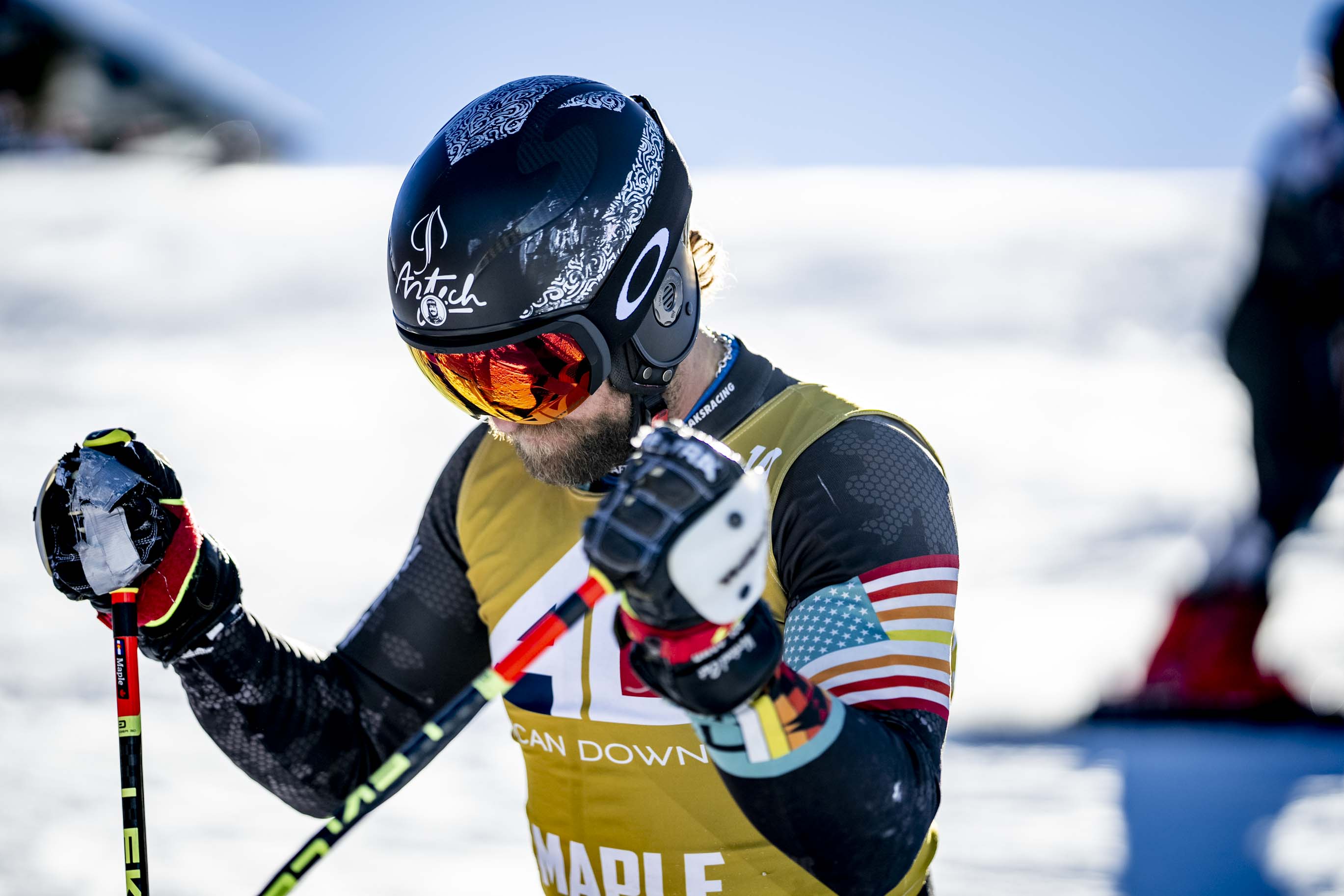
One of the most frustrating experiences in ski racing is skiing free and fast in training, then feeling tight, skiing cautious, and finishing slow on race day. Ski racers often assume this means they are missing something technically. In most cases, they are not. The difference between training speed and race speed is rarely physical. It is psychological.

In training, ski racers operate in an environment of safety. Mistakes are expected. Outcomes do not define them. Coaches give feedback, not judgments. Speed feels exploratory rather than evaluative. Because there is little emotional cost to failure in training, ski racers ski aggressively and instinctively.
Race day is a completely different animal, and it can feel like a beast.
Suddenly, performance is measured, ranked, judged, and remembered. Ski racers are no longer just skiing a course. They are racing against their own self-worth. This shift introduces expectations, pressure, doubt, worry, and stress, all of which change your thinking, your emotions, and your skiing.

When pressure rises, your primitive brain triggers your survival instinct and your fight-or-flight reaction. Your instinct is to protect yourself by overthinking, overcontrolling, and skiing safe. The problem is that your primitive survival instinct doesn’t work in 2026 ski racing. You start trying to ski fast in your mind instead of letting your body ski fast. Timing slows. Feel is lost. Flow disappears. You just ski slow.
This is why ski racers often say they “tried too hard” on race day. Over-trying is not a lack of effort. It is misplaced effort. The ski racer is attempting to force an outcome rather than execute a process.
Another major factor is identity threat. Many ski racers tie race results to self-worth, approval, or belonging. Thoughts like “I need to prove I belong here” or “I can’t disappoint my parents” turn skiing into a test of personal value. When ski racing feels like a verdict on who you are, you instantly go into survival mode. Speed is sacrificed at the altar of survival.

The ski racers who ski fastest in races are not those who want it most; every ski racer wants it most on race day. They are the ones who belief in their capabilities, trust their preparation, know that whatever happens they will still be loved and valued, and only focus on one thing in the start gate: get to the finish as fast as possible. They accept that going “full send” doesn’t always work out; mistakes, DNFs, or crashes happen in ski racing. But they also know that the only chance they have to get the results they want and to fulfill their big dreams is to take that risk. Finally, they know that going all out today may not pay off, but it will pay off at some point in the future, and that payoff will be big.
This is why the solution is not to “try harder” on race day. You should never “find another gear” or “step it up a notch.” That simply won’t work because if you haven’t done it in training, you’ll never be able to do it in a race. The solution is to train the mind to tolerate pressure without changing your skiing.
Training must include emotional realism. You need exposure to high stakes, consequences, and evaluation before race day. Timed runs, simulated races, “I’m going to crush you this run” challenges with teammates, all help narrow the gap between training and racing.
Equally important is separating your self-worth identity from your results. A race is something you do, not who you are. You are no less worthy of love, respect, and value if you finish 50th than if you finish 3rd, or don’t finish at all. When you come to really believe this, you ski without doubt, worry, or expectation, and you ski with confidence, courage, and commitment. You will be free to ski as fast as you are capable of. And, at the day, that’s all you can do.