
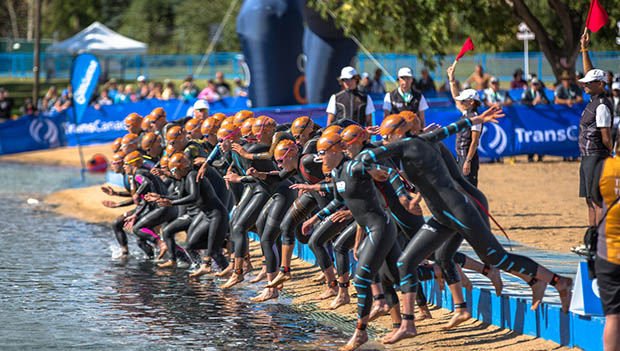
For most triathletes, swimming is the most frustrating discipline. Not because they are lazy or unmotivated, but because swimming is fundamentally different from cycling and running in ways many triathletes do not fully appreciate.

Understanding why swimming is so challenging is the first step toward improving it.
Why Swimming Is So Difficult
We humans live on land and don’t usually venture into the water unless we’re on some sort of buoyant object (e.g., innertube, surfboard, SUP, sailboat, motorboat). We can’t breathe underwater. We don’t naturally float. And open water can be downright terrifying because, well, drowning is a distinct possibility (which, sadly, happens more frequently in our sport than any of us would like). As a result, we are not natural swimmers. Existing in water is unfamiliar, and most people do not grow up learning how to move efficiently through it. Case in point. I learned to swim at an early age, but I stayed in the non-drowning category until well into adulthood when I became a triathlete.

Also, with running or cycling, there is a much more direct line between effort and improvement. If you train your body properly and put in sufficient effort, you will see fairly immediate gains in fitness and speed (though this trajectory is never entirely linear or continuous). Such steady progress is rarely seen in swimming. In fact, I speak from years of first-hand experience that it takes months and sometimes years to see meaningful improvements in speed.
The big question is: Why?
Swimming is a much more complex activity with multiple contributors to speed, efficiency, and physical demand. Additionally, basic swim movement patterns aren’t instinctive, so swimming requires learning an entirely new way to move and coordinate the body.

Technical factors (the biggest contributor, roughly 80 percent):
Stroke mechanics, propulsion, timing, and efficiency determine how well you move through the water.
Physical factors:
Anatomy, body composition, strength, cardiovascular fitness, flexibility, coordination, body position, relaxation, and awareness of where your body is in space all matter.
Mental factors:
Motivation, confidence, tolerance for impatience and frustration, anxiety, fear, focus, and overall mindset play a larger role in swimming than most triathletes realize.

Because of this complexity, effort in swimming does not translate directly into speed. Pushing harder or trying more often makes technique worse and speed slower.
Setting the Right Swim Goals
Because swimming is so technical, the goals you set matter.
Build a comfortable relationship with the water. This starts in the pool and eventually extends to open water. Comfort comes before speed.

Relax. Swimming faster does not come from muscling the water or forcing effort. It comes from a relaxed body, reducing resistance, and moving more efficiently.
Patience. Swimming improvement happens over months and years, not weeks. This reality is frustrating, but unavoidable. Triathletes who accept this reality enjoy swimming more and progress faster. Triathletes who fight it often stall.
Keys to Swim Improvement
If you want to improve your swimming, you need to approach it differently than cycling and running.

Become a student of swimming.
Learn what good technique actually looks like and why it works. Watch high quality instructional videos and pay attention to details like body position, timing, and rhythm, not just arm movement.

Get on-deck coaching.
Consistent and real-time feedback from an experienced swim coach is invaluable. Swimming is very difficult to self-diagnose. What you feel in the water is often not what is actually happening. This disconnect is due a lack of kinesthetic awareness which involves not having an accurate sense of how your body is moving through space.
Leverage technology.
Tools like FORM smart swim goggles provide real-time feedback that can help you stay focused on key elements of your stroke and preserve cognitive energy by freeing you from having to count strokes, remember distance, and recall lap times.
eoSwimBETTER palm-based sensors provide clear data on the forces you are generating and where you are losing propulsion in your stroke.

Video is also extremely powerful. Underwater views, side views, and on-deck footage can reveal problems you would never notice on your own. Video connects what you are feeling with what you are actually doing.
Drill, baby, drill.
Like most areas in our lives we want to improve, there is no magic and there are no quick fixes in swimming. The only way to improve is through consistent focused repetition of the correct movement. That’s why top triathletes and swimmers devote a significant part of their workouts to drills. They understand that proper technique is essential to fast swimming and repetition is the only way to ingrain proper technique.

Mental Training for Swimming
Improving your swimming is not just about drills and yardage in the pool. What happens between your ears also has a huge impact.
Use imagery.
Regularly visualize yourself swimming with good technique. See and feel smooth strokes, controlled breathing, proper head and body position, and relaxed movement through the water.
Increase kinesthetic awareness.
During swims, focus on one aspect of your stroke at a time. This might include head position, breathing mechanics, hand entry, the catch, the pull, the exit, the feel of the water on your palms and forearms, body position, or the kick. This focused attention builds awareness and control.

Prioritize relaxation.
Comfortable breathing, long strokes, and smooth rhythm are foundational. Tension creates drag and disrupts timing.
Use feedback tools wisely.
If you use technology, include what you learned from the data into your workouts. Pay attention to real-time metrics and cues, but do not overload yourself. Choose one or two priorities per session.
Be patient.
Patience may be your most important mental muscle in swimming. With patience, you will maintain a healthy perspective on your swimming journey. You will set reasonable expectations of how much and how quickly you will improve, You will stay positive and motivated through the inevitable setbacks, plateaus, and frustrations that you a part of trying to become a better swimmer. And you will give yourself the time that is required to make the gains you seek with such determination.

Cool-Down
Swimming rewards triathletes who accept, respect, and leverage its complexity. The more you work with the water, instead of fighting against it, the more progress you will make and the more likely you’ll achieve your triathlon goals.