
When triathletes think “tech,” they picture power meters, HR monitors, and GPS devices—but gear has always played a pivotal role, long before Silicon Valley existed. From goggles to carbon plates, every innovation helps us swim, bike, and run faster. Most recently, I’ve discovered a wetsuit technology that’s revolutionized both my speed in the pool and my mindset about swimming.
A Late Bloomer in the Water
I didn’t grow up swimming. I logged my first lap in adulthood—definitely in the “non-drowning” category. Watching lifelong swimmers, it’s clear how naturally they move in water. Their effortless flow always intimidated me. And I had resigned myself to being a very mediocre swimmer and having to play catch up after the swim in every race.
That changed when fractions of a second became the margin between medals. At the Super‑Sprint World Championships in Spain last September, I clinched bronze by less than a second. But at the USAT Nationals in Milwaukee last August, I missed silver by seven seconds. I began hunting for tech margins—like wetsuits—that might help me claw back that lost time.
Enter deboer Fjord 4.0
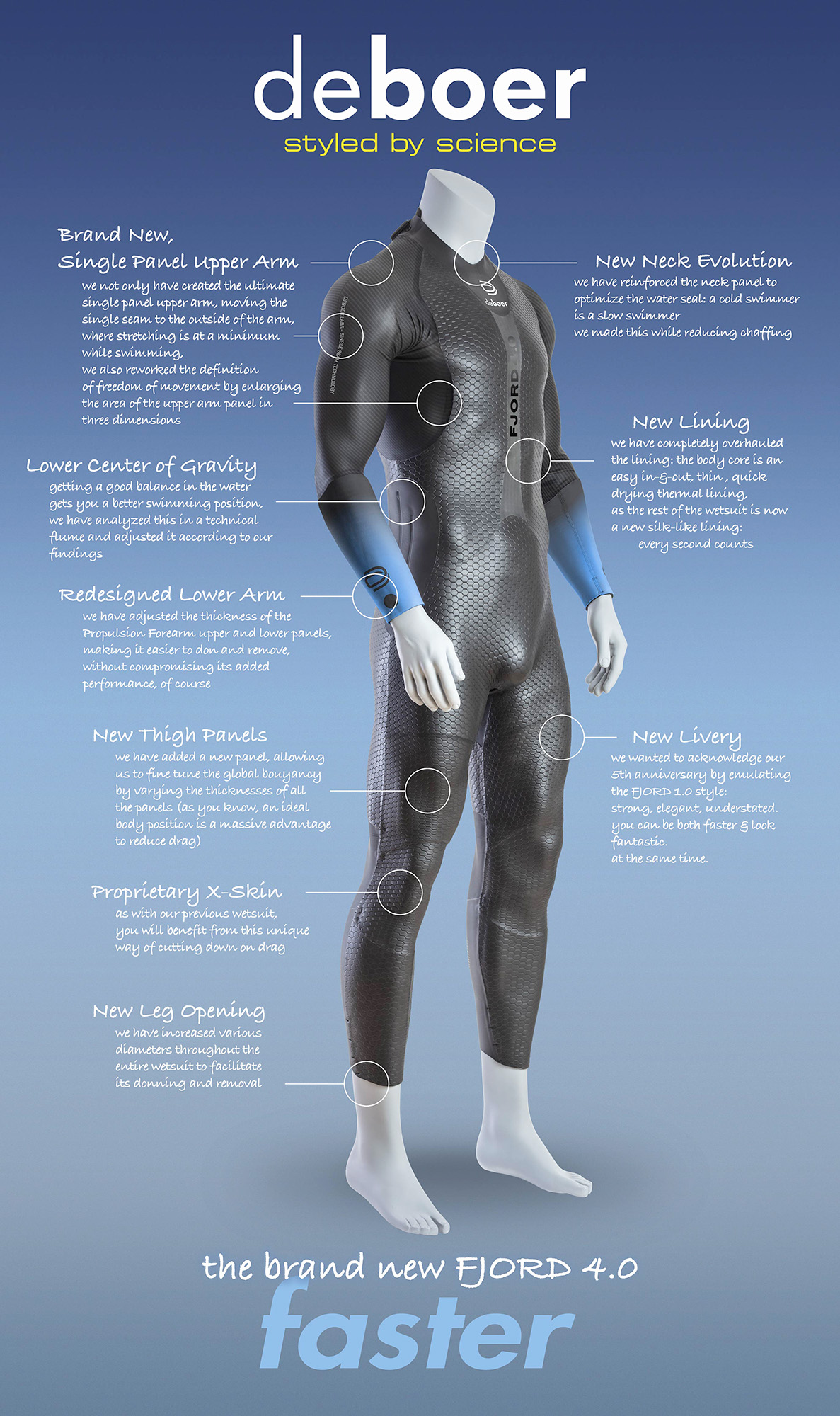
For years, my go-to was the Roka Maverick Pro II—one of the fastest suits on the market. Then I discovered Santara Technology’s empirical approach to wetsuit design and decided to try something radically different: the new deboer Fjord 4.0.
Aesthetically it jumped out of the box—thicker forearms, ultra-thin shoulders, and biomimetic “fish scale” panels emulating nature’s hydrodynamic designs. After slipping it on for the first time, I felt weightless—like gliding. My swim stroke felt untethered.
The Numbers Don’t Lie
In a controlled pool test (300 yards per set):
- Swimsuit: ~1:55/100y
- Roka Maverick Pro II: ~1:45/100y
- deboer Fjord 4.0: ~1:35/100y
That’s a staggering 20 seconds faster than a swimsuit, and 10 seconds faster than the Roka—on paper, one of the fastest wetsuits out there.
What Science Says
Recent studies reinforce these observations:
- A 2025 analysis by Dan Daly highlights that wetsuits enhance buoyancy, streamline posture, and reduce drag—making swimmers more efficient. Full-sleeve suits, in particular, improve economy by roughly 12%–16%, depending on coverage.
- A 2022 systematic review found speed gains ranging from 3.2% to 12.9% in front‑crawl performance, across varied distances and settings.
- Meanwhile, the deboer Fjord 4.0 was developed via swimmer feedback, T3 flume testing, and biomechanical innovation. Key features include enhanced buoyancy, flexible seaming, and hydrophobic coatings to reduce drag.
The Psychological Power of Fast
Motivation
Swimming has long been my least favorite leg. Training at 5:30 am, I’d hit snooze more often than not. But wearing the Fjord 4.0 twice weekly has been like a caffeine injection—I’m genuinely excited to train, even before dawn, knowing the suit gives me a real edge.
Confidence
For the first time, I believe I can emerge from the water closer to the leaders. Even a modest half of the pool-test advantage translates to a 20-second gain over 400 yards and potentially 1–2½ minutes over Olympic distance. That margin could change everything.
Emotion
Triathlon is as much emotional as physical. Swimming in this suit ignites pride, inspiration, and fuel—I feel “look fast, feel fast, go fast” in every stroke.
Final Thoughts
The deboer Fjord 4.0 isn’t just a wetsuit—it’s a game-changer. Its speed is backed by science and lived experience. If you struggle in the swim, or you just swim in the dark and cold, maybe the right tech won’t just make you faster—it might just reignite your passion for swimming.